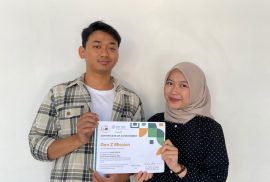
The Department of Food and Agricultural Product Technology (TPHP) at Universitas Gadjah Mada (UGM), in collaboration with PT Laborindo Sarana, organized a seminar and workshop on the Perten Rapid Visco Analyser (RVA) on July 28, 2026, at Room 384 of the Faculty of Agricultural Technology. Through a combination of expert lectures and hands-on training sessions, the program provided participants with a comprehensive understanding of the operation of the RVA and its applications in food research, quality control, and product development.
The event featured Laura Levin, Rheology Applications Manager at Perten, a PerkinElmer company, alongside Prof. Dr. Yudi Pranoto, S.T.P., M.P., a faculty member of the Department of TPHP at UGM. Participants explored the fundamental principles of RVA technology, analytical methods, data interpretation, and the instrument’s broad applications within the field of food science.
The program commenced with opening remarks delivered by Dr. Dwi Larasatie Nur Fibri, S.T.P., M.Sc., Secretary of the Department of TPHP at UGM, followed by a welcoming address from Alvin Gunadi, Project Manager of PT Laborindo Sarana. The seminar represented an ongoing collaboration between academia and industry aimed at introducing emerging technologies in food analysis to students, researchers, and faculty members.

During the first session, Laura Levin delivered a presentation entitled Introduction to Perten Instruments and the Perten Rapid Visco Analyser. She introduced the underlying principles of RVA technology and explained how the instrument measures changes in sample viscosity under carefully controlled heating and cooling conditions.
Levin also highlighted the extensive applications of RVA technology in quality assurance and food manufacturing. While the instrument is widely used for starch analysis, its applications extend to a broad range of food materials and products. The resulting data provide valuable insights into raw material characteristics, product consistency, and changes in material properties during processing.

The second session, led by Prof. Dr. Yudi Pranoto under the theme Sharing Research Experiences: Applications in Food Research and Innovation, focused on the practical implementation of analytical instruments in food science research and innovation. Drawing upon his professional experience, he illustrated how viscosity analysis can support ingredient selection, formulation development, and quality assessment in food products.
Following a break, participants attended laboratory visits, workshops, and live demonstrations of the Rapid Visco Analyser. The sessions offered direct exposure to the instrument’s operation, including sample preparation, method selection, test parameter configuration, and the interpretation of analytical curves generated from the measurements.
Wika, a student in UGM’s Food Science and Technology program, described the event as both insightful and highly relevant to the field of food science.
“The presentations were exceptionally informative and easy to follow, particularly the discussion of RVA applications across various sectors of the food industry. The seminar broadened our understanding of the instrument’s capabilities, demonstrating that its use extends far beyond starch analysis to encompass many different types of food samples.”
According to Wika, the workshop component also provided valuable practical experience.
“The opportunity to operate the RVA directly enabled participants to gain a clearer understanding of both the instrument itself and the interpretation of analytical results. In the future, it would be beneficial to include additional material on the industrial applications of laboratory instruments and to extend the duration of the workshop sessions.”
The event concluded with a discussion session and closing remarks. Through this initiative, participants were expected to strengthen their ability to apply RVA-based analytical techniques in laboratory practice, research activities, quality assurance processes, and the development of innovative food products.