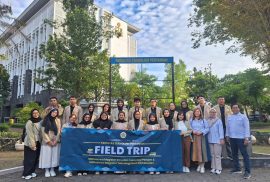
Yogyakarta — The Department of Food and Agricultural Product Technology, Universitas Gadjah Mada (TPHP UGM), continued its efforts to bring industry perspectives into the classroom through a guest lecture designed to broaden students’ understanding of real-world food safety practices. The session featured TPHP UGM alumna Fitri Asih Victoria, Regional Manager of PT Boga Makmur Wijaya, and was held on Monday (Apr. 28), as part of the Food Industry Sanitation course.
In her lecture, Fitri highlighted the essential role of restaurants as providers of both food products and services. She emphasized that service quality must go hand in hand with food safety assurance. In this context, the implementation of Hazard Analysis and Critical Control Points (HACCP) plays a critical role in minimizing contamination risks. Key control measures include monitoring storage temperatures in warehouses, chillers, and freezers, as well as ensuring that food is heated according to established safety standards.
Fitri also outlined the fundamental differences between large-scale food manufacturing and restaurant operations. While large food industries often rely heavily on automation and machinery, restaurant operations remain highly dependent on human labor. This makes personal hygiene a crucial aspect of food safety management. Employees are expected to comply with hygiene standards, including maintaining clean uniforms and ensuring good health conditions, to prevent potential contamination.
The lecture further addressed the importance of implementing a Pest Management System. Restaurants must establish preventive measures to limit pest entry while maintaining routine environmental sanitation. In addition, allergen management was discussed as a key component of consumer safety, particularly through the provision of clear information on menu ingredients, enabling customers to make informed and safe food choices.
Students were also introduced to the role of Quality Assurance (QA) in maintaining product and service quality, including workforce certification procedures and customer complaint handling across restaurant networks. To encourage participation, the session included case studies delivered through an interactive quiz, prompting active discussion among students.
Beyond offering practical industry insights, the guest lecture also contributed to the advancement of the Sustainable Development Goals (SDGs), particularly Goal 3 on Good Health and Well-being and Goal 12 on Responsible Consumption and Production. By strengthening students’ understanding of sanitation practices in the food service industry, the activity underscored the importance of food safety in supporting broader public health.
Author : Firstnandita Keisha