
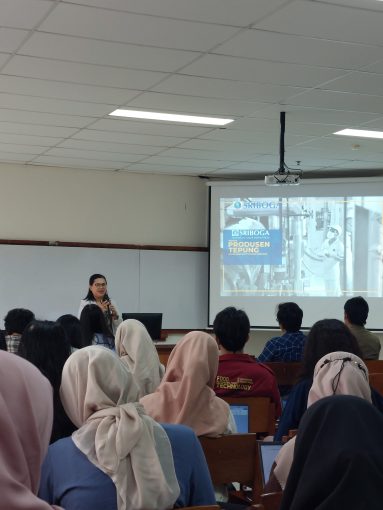
Agricultural Product Technology (TPHP), Universitas Gadjah Mada, held a guest lecture series featuring Maria Nur Haryati from PT Sriboga Flour Mills. The lecture was integrated into the undergraduate course Legumes, Cereals, and Tuber Technology and delivered in two sessions: “Wheat and Flour Technology” on September 23, 2024, conducted onsite at the Faculty of Agricultural Technology, and “Wheat Flour Application” on October 14, 2024, held online via Zoom.
Wheat and Flour Technology
Maria began by tracing the historical roots of wheat cultivation, dating back to ancient civilizations in modern-day Turkey, Syria, Iraq, and Iran, eventually reaching China by 2700 BCE. Today, China remains the world’s largest wheat producer, followed by the European Union and India, while Indonesia ranks among the top wheat consumers, relying heavily on imports.
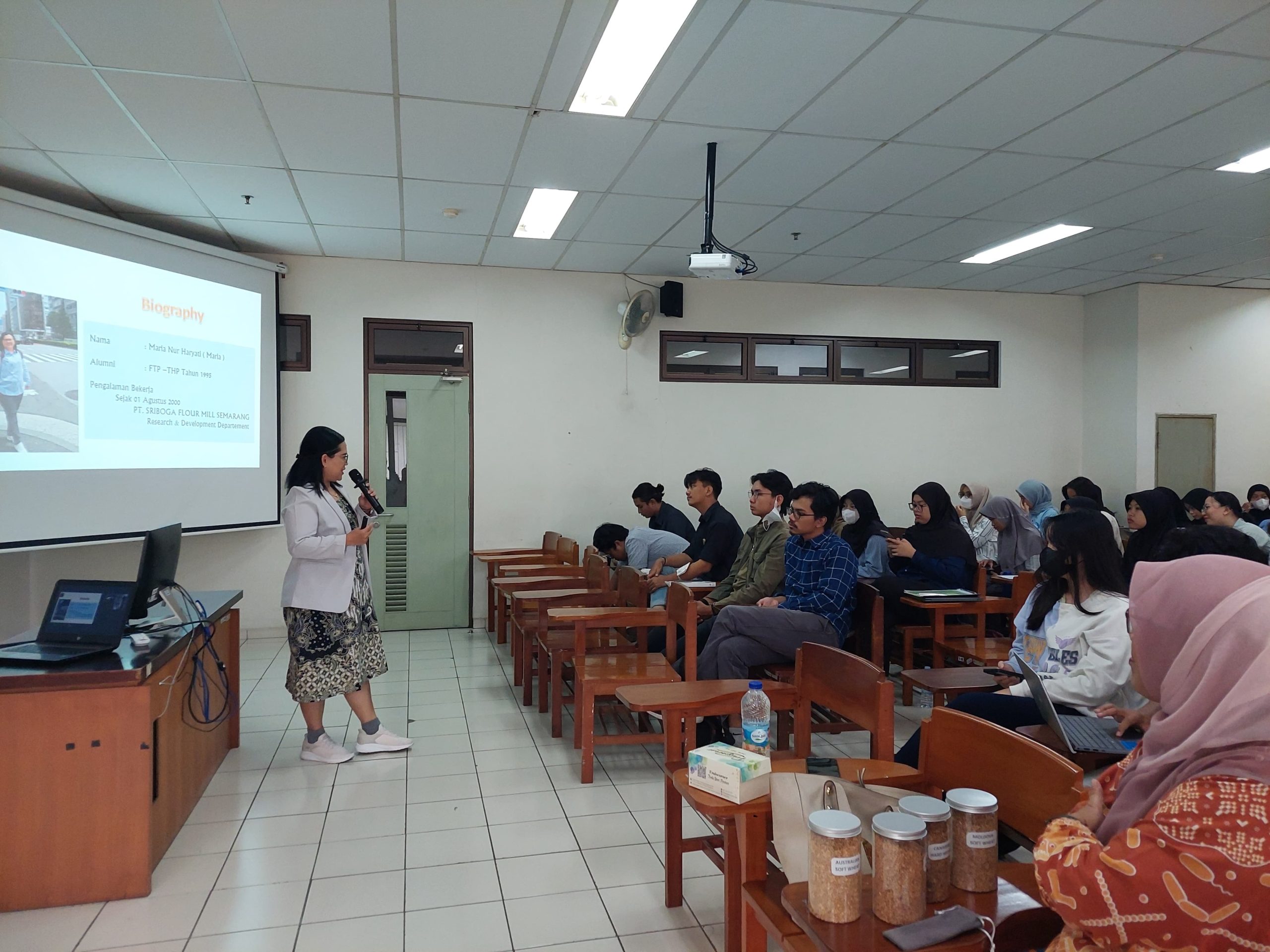 The session delved into the compositional and physical characteristics of wheat, which vary by origin and influence quality and application. On average, wheat consists of 70–75% starch, 10–15% protein, 14% moisture, and 1–2% fat. Moisture content is particularly critical for storage stability, as excess moisture can shorten shelf life.
Maria also discussed the wheat milling process, which involves multiple steps and equipment to ensure purity and quality. Devices such as magnetic separators, aspirators, dry stoners, and purifiers are used to remove impurities. Quality control tools—like farinographs and extensographs—ensure that the final flour meets industry specifications. High-grade flour is distributed to the food market, while lower-grade by-products are repurposed as agricultural inputs.
Wheat Flour Application
The second lecture focused on how wheat flour is classified and utilized in food production. Maria explained the three major types of wheat flour—high-protein, medium-protein, and low-protein—and their respective roles in producing various food products.
- High-protein flour is ideal for bread and noodles, thanks to its elasticity.
- Medium-protein flour suits pastries, donuts, and pound cakes.
- Low-protein flour is preferred for cookies, biscuits, and fried snacks.
 She further elaborated on the fermentation and baking processes critical to breadmaking, emphasizing the importance of temperature and humidity control to achieve desirable texture and quality. Similarly, noodle production varies based on the type—raw, wet, dry, or instant—and includes stages such as mixing, resting, sheeting, cooking, and packaging. The inclusion of additives like preservatives, colorants, and elasticity enhancers plays a vital role in enhancing shelf life and consumer appeal.
Beyond technical insights, the lectures highlighted the broader impact of wheat processing technology on Sustainable Development Goals (SDGs). Efficient wheat flour production contributes to SDG 2 (Zero Hunger) by supporting food security and reducing hunger, and SDG 9 (Industry, Innovation, and Infrastructure) by advancing quality control technologies and industrial processes.
Maria’s lectures offered students not only a window into real-world food manufacturing practices but also a deeper appreciation of how technological innovation can support sustainable and resilient food systems. The Department hopes that such industry collaborations will continue to enrich students’ academic experience and prepare them for future contributions to the global food industry.
Written by: Anisa Quentina


