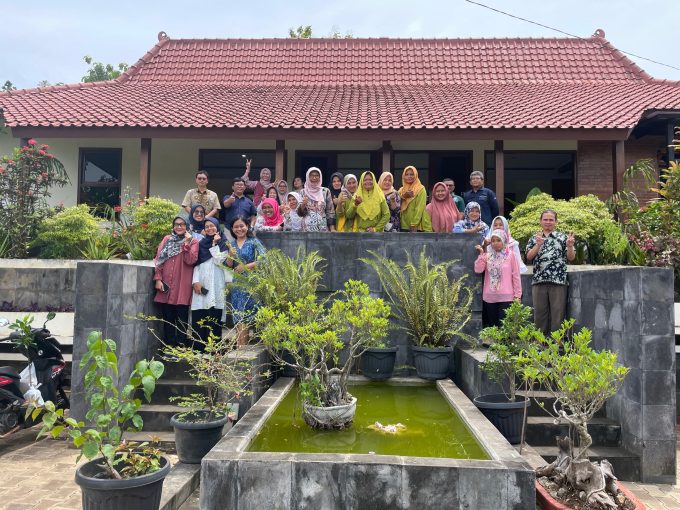
Utilizing local natural resources can bring multiple benefits, particularly in strengthening the local economy. On Tuesday (January 4), several Women Farmers’ Groups (Kelompok Wanita Tani, KWT) from Gunung Kidul—representing the villages of Srikoyo, Karang Asem, Piyuyon, and Banyumanik—participated in a community service program led by lecturers from the Department of Food and Agricultural Product Technology (TPHP), Universitas Gadjah Mada (UGM). The activity focused on transforming cassava into manggleng, a traditional crispy snack, and was held in collaboration with Banyumanik Research Centre.

The event opened with welcoming remarks from Dr. Ir. Priyanto Triwitono, M.P. (TPHP UGM), and Mrs. Sri Astuti Soedjoko (Banyumanik Research Centre), followed by a theoretical session on food packaging. The session was delivered by Bangun Prajanto Nusantoro, S.T.P., M.Sc., and Dr.rer.nat. Lucia Dhiantika Witasari, S.Farm., Apt., M.Biotech., who introduced various types of packaging commonly used in small-scale businesses, such as pouches, cans, and woven bamboo containers (besek). Mr. Bangun emphasized the importance of choosing packaging materials based on the type of product and ensuring food-grade standards, while Dr. Tika discussed labelling requirements in greater detail.
 The session continued with a discussion on appropriate technology, led by Dr.nat.techn. FMC Sigit Setyabudi, S.T.P., M.P., and Dr. Priyanto. Participants learned basic drying techniques, both traditional sun drying and mechanical drying using a cabinet dryer. Dr. Priyanto highlighted the advantages of using a cabinet dryer, which can produce more visually appealing products with consistent quality.
A hands-on session on manggleng production followed, facilitated by Dr. Rini Yanti, S.T.P., M.P., Dr. Lulum Leliana, S.T.P., and Wahyu Dwi Saputra, S.T.P., M.Agr.Sc., Ph.D., along with three student assistants: Aisha, Dinda, and Maretha. The participants enthusiastically engaged in the practical activity, with lively discussions between faculty members and participants on improving techniques and product quality.
 This community service program aligns with multiple Sustainable Development Goals (SDGs), including SDG 1 (No Poverty), SDG 8 (Decent Work and Economic Growth), SDG 9 (Industry, Innovation, and Infrastructure), and SDG 12 (Responsible Consumption and Production). With the skills gained from this training, the KWT members are expected to develop higher-value cassava-based products, improve their market competitiveness, and contribute to sustainable local economic growth.
Written by: Firstnandita Keisha