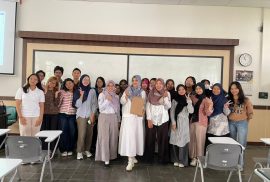
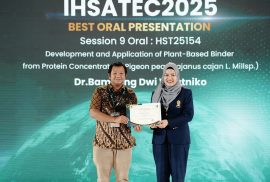
Yogyakarta – Students of the Master’s Program in Food Science and Technology at the Department of Food and Agricultural Product Technology, Universitas Gadjah Mada, have once again brought distinction to the university through an outstanding achievement on the international stage. Fiki Ni’matul Jannah and Nur Afni Rezkika were recognized at the 2nd International Student Summit (2nd ISS) 2026, held in Kuala Lumpur, Malaysia, on 14–15 February 2026, where they earned the Gold Medal, Best Presentation Award, and 3rd Winner Overall.
The summit was organized by the Sentosa Foundation in collaboration with the International Student Association (INSAN), Universiti Sains Islam Malaysia (USIM), and the World Association of Young Scientists (WAYS). Their success reflects not only individual excellence, but also the growing presence of UGM students in international academic forums that value innovation, interdisciplinary thinking, and global relevance.
At the summit, Fiki Ni’matul Jannah and Nur Afni Rezkika presented an innovation aimed at advancing food safety through the real-time monitoring of chicken meat quality. As one of the most widely consumed sources of animal protein, chicken meat remains highly vulnerable to quality deterioration caused by microbial contamination, particularly within open-market distribution systems such as traditional markets. In many cases, such deterioration may not be immediately apparent to consumers, as the product can still appear visually acceptable despite having undergone microbiological spoilage that poses potential health risks.
In response to this challenge, the team developed an intelligent biopackaging system in the form of a smart sticker derived from dragon fruit peel extract, which contains betalain pigments—natural compounds known for their sensitivity to pH changes. The innovation is further integrated with MeatSafe, a smartphone-based application capable of detecting and analyzing color changes through the device’s camera, thereby enabling consumers to assess meat quality in a more objective, accessible, and practical manner. Beyond its functional value in food quality monitoring, the innovation also demonstrates a commitment to sustainability by transforming dragon fruit peel waste into a value-added material, underscoring the relevance of circular economy principles in contemporary food systems.
The project also resonates strongly with the broader framework of the Sustainable Development Goals (SDGs). Its emphasis on food safety and consumer protection aligns with SDG 3: Good Health and Well-being, while its use of agricultural by-products as functional materials supports SDG 12: Responsible Consumption and Production. At the same time, the development of natural-material-based smart packaging integrated with digital technology reflects the aspirations of SDG 9: Industry, Innovation and Infrastructure.
This recognition stands as a testament to the ability of UGM’s graduate students to produce work that is both academically rigorous and socially meaningful. The accomplishment of Fiki Ni’matul Jannah and Nur Afni Rezkika not only highlights their scholarly promise, but also affirms the role of higher education in fostering innovations that respond to pressing societal needs and global challenges.
Writer: Firstnandita Keisha