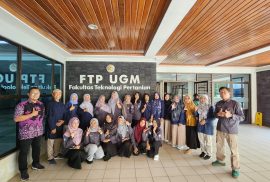
Semarang, October 16, 2025 — The Department of Food and Agricultural Product Technology (TPHP), Faculty of Agricultural Technology, Universitas Gadjah Mada, organized an industrial visit for first-year students of the 2025 cohort. Part of the Introduction to Agricultural Technology course, the visit took place on Thursday (10/16) to two major food manufacturing companies in Semarang, Central Java: PT Marimas Putera Kencana (Marifood) and PT Indofood CBP Sukses Makmur Tbk, Noodle Division. The program was designed to help students connect classroom learning with real industrial applications, while also aligning with the spirit of sustainable food development and decent economic growth.

At PT Marimas Putera Kencana, students observed the complete process of powdered beverage production—from raw material preparation and mixing to automated packaging. Each machine is capable of filling up to 2,000 sachets per day, enabling the factory to produce around 20,000 sachets daily.
The visit also included a tour of the Quality Control (QC) room, where students learned how product and packaging quality are tested to maintain safety and consistency. While product QC ensures every batch meets internal standards, packaging QC checks for leaks or damage that could lead to contamination risks. Throughout the visit, students were guided by faculty members and production supervisors, who explained each step of the process and answered participants’ questions. The session concluded with an informal gathering where the company treated students to refreshments.
The second visit took place at PT Indofood CBP Sukses Makmur Tbk, Noodle Division, where students observed the instant noodle production line from a viewing platform above the factory floor. They witnessed each stage—from dough sheeting and frying to primary packaging—all carried out through fully automated systems with minimal human contact. Operators monitor the machinery to ensure smooth and consistent production.
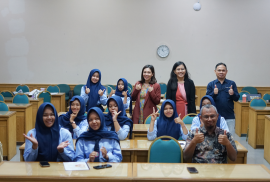
Following the tour, students gathered in the company’s auditorium for a presentation by Mr. Bagus Bayu Prabowo Aji, Industrial and Public Relations representative at Indofood CBP Noodle Division, Semarang. He shared insights on the history of instant noodle development and addressed several common misconceptions, such as the use of wax as a preservative or the suggestion to discard the cooking water.
He explained that preservation is achieved through frying, which reduces moisture content to below 10%, preventing mold and microbial growth. He also emphasized that the cooking water should not be discarded, as it contains water-soluble B vitamins added during fortification. During the Q&A session, students learned that each instant noodle brand differs in ingredients and texture, tailored to meet specific market standards, including those for international markets.

Through this industrial visit, first-year TPHP UGM students gained valuable exposure to the practical applications of food technology in real-world settings. The experience is expected to deepen their understanding of food safety and production systems, foster curiosity about food manufacturing processes, and inspire future contributions to Indonesia’s sustainable food industry.
Written by: Okta I. Latifa